

Yizhou, Guangxi: the raw silk origin behind the cloth
Yizhou is the largest raw silk producing county in China. It reels 5,463 tonnes of raw silk a year — 13.4% of national output. It has held first place among Chinese counties for sericulture scale for twenty consecutive years (Yizhou District Government, 2023). The local mills we work with draw from this district. What follows is what the official figures actually say. It also covers where the widely repeated versions are wrong. Then it explains why the origin matters to a buyer specifying cloth rather than a story.
Four terms this page uses
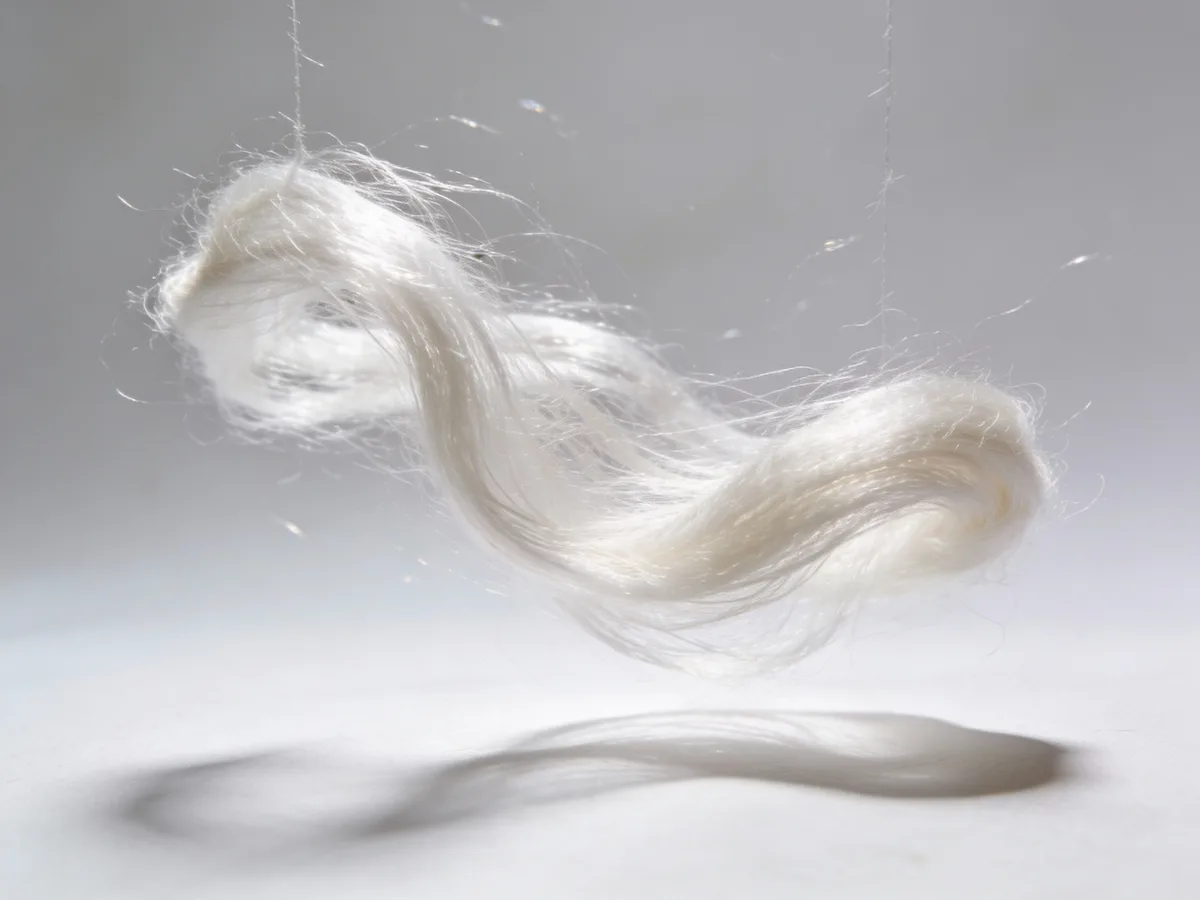
Raw silk is the filament reeled directly from cocoons and twisted into yarn, before any weaving. Reeling is that first process. Cocoons are softened, the filament is found and joined, and the yarn is wound onto a bobbin. Greige is the cloth that leaves the loom undyed and unfinished. Lot mark is the identifier a reeling run carries into export packing. It is how a certificate is matched to the bale in front of you.
Grading, moisture content and lot marking are set by the national raw silk standard, GB/T 1797-2008 (Standardization Administration of China, 2008). A certificate that cannot be tied to a lot mark is not evidence of anything.
One clarification before the numbers.
“World’s largest raw silk origin” is a fair phrase. It rests on a chain of facts rather than on a single published ranking. China produces the large majority of the world’s mulberry silk, and Yizhou is the top county within China. We state the domestic ranking because it is published and checkable. A supplier who gives you a global percentage without a denominator is guessing.
The official figures, with their qualifying conditions
Statistical scope matters more than most buyers expect. Yizhou district and Hechi prefecture publish different numbers for the same thing. And “silk processing output” is not the same measure as “total cocoon value”. Each figure below carries the scope it belongs to.
The district figures come from the Yizhou district government profile (Yizhou District Government, 2023). The prefecture-level figures and the county ranking come from the Hechi civil affairs bureau (Hechi Civil Affairs Bureau, 2025). For example, the 39.6 万亩 plantation figure is Yizhou alone, while the prefecture reports 96.6 万亩 for the same crop.
| Figure | What it measures | Scope |
|---|---|---|
| 39.6 万亩 / 396,000 mu | Mulberry plantations in Yizhou | Yizhou district only — not the wider Hechi prefecture, which reports 96.6 万亩. |
| 10.9 万吨 / 109,000 t | Fresh cocoon output, annual | Yizhou district. |
| 20 years | Ranked first among all Chinese counties for sericulture scale | Consecutive years, per the district government's 2026 statement. |
| 5,463 t | Raw silk output, annual | 13.4% of national raw silk output. |
| 15+ years | Ranked first nationally for raw silk output | Official sources differ between 15 and 16 years depending on the data year cited; we state it as 15 years or more rather than pick one. |
| 30,000 mu | Organic mulberry plantation | Certified under China Organic in 2024. |
| 20 | Silk enterprises above designated size | Of 277 sericulture businesses and individuals in the district; 4 hold export qualifications. |
| ¥3.262 bn | Silk processing output, 2024 | Above-designated-size silk processing only, up 11.3% year on year (Yizhou District Government, 2025). Not the same measure as the district's total cocoon value of roughly ¥6 bn. |
Sources are listed at the foot of this page. Figures are as published by the Yizhou district government and national statistics reporting in 2025–2026.
From cocoon to yarn: six stages
Most sourcing pages describe raw silk as a commodity with a price per kilo. It is a manufactured product with six decision points. Every one of them shows up later as a defect or a clean run on your loom.
01
Cocoon selection
Cocoons are graded before anything else. Double cocoons, thin-shelled cocoons and stained cocoons go to different streams. The double cocoons are what later become dupion yarn, which is why dupion is a sorted grade rather than a defect.
02
Stifling and drying
Heat stops the pupa from developing and drives moisture out of the shell. Moisture control here is the difference between a yarn that keeps its denier through shipping and one that gains weight and loses strength.
03
Cocoon cooking
Hot water softens the sericin gum so the filament can unwind without breaking. Under-cooked cocoons break; over-cooked ones lose cohesion. This is a feel-and-timing skill, not a setpoint.
04
Reeling (filature)
Six to nine filaments are drawn off together and twisted into a single thread. That grouping is what produces 20/22 denier. It is a range rather than an exact figure, because cocoon shells vary and the reeler is continuously adjusting.
05
Rewinding
The reeled silk is transferred to bobbins or books, inspected for slubs and breaks, and graded. Evenness, cleanness and neatness are assessed here — the three measures behind a 4A, 5A or 6A grade.
06
Packing
Yarn is packed into export bales with moisture content controlled below 11% (GB/T 1797-2008), marked by lot so a batch can be traced back to its reeling run.
Why the grade is decided before the yarn is sold
A 6A grade is not a marketing tier. It is the outcome of three measured properties, each assessed on the reeled yarn:
Evenness
Variation in denier along the thread. A yarn that swings between 19 and 24 denier will weave, but the cloth will show it as barré. Horizontal bands that only appear after dyeing, when it is far too late to reject the yarn.
Cleanness
Count of larger defects per unit length. Slugs, bad casts, waste. These become slubs in the finished cloth. In dupioni a slub is the point of the fabric. In a habotai lining it is a reject.
Neatness
Count of smaller imperfections. This is the measure that most often separates 5A from 6A. It is invisible on a swatch until the cloth is dyed dark.
Grade covers the fibre only. It says nothing about momme, which describes woven cloth, and nothing about weave. Those are separate decisions documented in the momme guide and the fabric construction index.
The luxury raw-material claim, stated precisely
The district government’s published account states that Yizhou’s high-grade raw silk supplies the raw material chains of Louis Vuitton and Hermès. That is the claim, and it is a meaningful one. It means the top of the local grade range is good enough for houses whose rejection standards are brutal.
It is also narrower than it is often repeated as. Being an origin for a luxury raw material chain is not the same as being a named supplier to that house. Fibre moves through reeling, trading, weaving and finishing before it reaches an atelier. The brand at the end rarely knows the county. We report the official statement as written and stop there. We do not extend it to brands the source does not name, and we do not claim a direct relationship we cannot evidence.
How Yizhou differs from the regions buyers usually name
Buyers often ask for “Suzhou silk” or “Como silk”. What they mean is a quality level or a finishing standard. These are different links in one chain, and confusing them is how a specification drifts.
Yizhou, Guangxi
Fibre originCocoon growing and reeling. The output here is raw silk yarn and greige cloth — the input to weaving, not the finished fashion fabric.
Suzhou, Jiangsu
Craft and finishingEmbroidery, dyeing, finishing and a long couture tradition. Strong on craft narrative; it is not a raw silk origin in the same sense.
Hangzhou, Zhejiang
Weaving and OEMHigh-volume weaving and garment OEM. The place your fabric is likely woven if it is not woven in Guangxi.
Como, Italy
European finishingDyeing, finishing and quality grading for European luxury houses. Most of the raw fibre it processes is imported — including from China.
Where we sit in this
We work with local mills in Yizhou rather than describing ourselves as a trader who found a good price. That distinction matters operationally. It is why we can tell you which reeling run a lot came from. It is why we push back when a specification will not survive degumming. And it is why we refuse to quote a construction the mills cannot actually weave at your quantity.
For example, a buyer may ask for a 16 momme charmeuse at 140 cm. The question we can answer is whether the local mills can hold that width and weight in the same run. The second question is what the graded yarn behind it will be. That answer comes from the reeling floor rather than a catalogue page.
The other half of our position is that we are a couture house first. Cloth is judged here by what it does on a body under movement and light. That is the standard which produced the Forbidden City jacquard cape and the hand-embroidered Oscars gown. A mill specification sheet will not tell you that a cloth photographs grey under flash. It will not tell you that it creases at the hip after twenty minutes of sitting. We will.
Mulberry raw silk yarn
20/22D white, dupion, luxury and GOTS-certified organic, in 4A–6A grade, supplied by weight to weavers and embroiderers.
View specification →Greige silk fabric
Undyed cloth off the loom, for buyers running their own dyeing and finishing — and the honest starting point for a momme conversation.
View specification →Questions about the origin
Is Yizhou really the world's largest raw silk origin?
Yizhou is the largest raw silk producing county in China, and China produces the large majority of the world's mulberry silk. So the phrase is accurate as a description of the county's position. It is worth being precise about what it rests on: 5,463 tonnes of raw silk a year, 13.4% of national output, and twenty years in a row at number one among Chinese counties for sericulture scale. Those are the verifiable figures. Anyone quoting a global percentage should show the denominator.
What is the difference between Yizhou silk and Suzhou silk?
They sit at different points in the chain. Yizhou grows cocoons and reels raw silk — it is an origin. Suzhou is a weaving, embroidery and finishing centre with a long couture tradition. Suzhou buys fibre; Yizhou produces it. A garment described as Suzhou silk is usually describing where it was made or embroidered, not where the filament came from.
Which luxury brands use Yizhou raw silk?
The district government's own published account states that the region's high-grade raw silk supplies the raw material chains of Louis Vuitton and Hermès. We report that as the official statement it is. We do not extend it to brands the source does not name. Being an origin for a luxury house is not the same as being its named supplier. The fibre usually passes through several hands before it reaches a European atelier.
What does 20/22 denier mean?
Denier measures the weight of 9,000 metres of filament. 20/22D means the yarn falls in a band between 20 and 22 denier. It is a range rather than a fixed number, because it is reeled from natural cocoons whose shells vary. It is the standard spec for mulberry raw silk in international trade, and it differs from momme, which describes woven cloth.
Why does raw silk from one region behave differently from another?
Three variables: the mulberry leaf, the climate, and the reeling discipline. Leaf quality drives filament strength and length. Heat and humidity through the growing season affect cocoon shell thickness. Reeling practice decides how much of that potential survives into the yarn. Two regions can run the same silkworm breed and still produce yarn that breaks at different rates.
Can I visit or audit the supply chain?
Buyer factory audits are possible and we publish the checklist we work to. If you are arranging a visit, tell us in advance what you need to see: reeling floor, grading records, lot marking, moisture testing. Not every stage happens at the same site, and some require the mill to schedule around production.
Sources
- Yizhou district government, statement published via China Textile Economic Information Network, March 2026 — plantation area, cocoon and raw silk output, enterprise counts, processing output, luxury raw-material statement.
- National Bureau of Statistics, China Information Daily, 2026 — Hechi prefecture sericulture scale, white steam filature and greige cloth output, local processing rate.
- People’s Daily Guangxi, March 2025 — consecutive-year rankings and organic mulberry certification.
- Yizhou district government portal — reopening of the Guangxi all-silk Zhuang brocade production line at Guangxi Jialian Silk.
Where official sources disagree on a year count. This page states the conservative version and says so rather than picking the more flattering number.
Continue through the sourcing guides
Ask for the lot records
If the origin matters to your customer, ask us for what backs it. That means lot marking, grading certificates, moisture figures and the export documents that travel with the bale. Samples carry no material charge; you cover the courier.
Sources and method
Methodology: every figure on this page is taken from a published government profile. The two qualifiers that travel with it (administrative scope and statistical measure) are stated in the same row. Where official sources disagree, as they do on the number of years at first place for raw silk output, the page states the conservative figure and says so. The six reeling steps describe the standard process, not one mill's line. Grading and moisture rules follow GB/T 1797-2008. Reeled silk is a commodity with published standards, so this page cites the standard rather than a supplier's brochure.
- Yizhou District Government: Yizhou district profile (2023). Mulberry plantation area, cocoon output, raw silk output and the 13.4% national share.
- Hechi Civil Affairs Bureau: Hechi place names: Yizhou (2025). The county-level sericulture ranking and the updated mulberry and cocoon figures for the wider prefecture.
- People's Daily: Following the light: film locations in China and abroad (2015). The Painted Veil location history and the director's account of choosing the Guangxi landscape.
- Guangxi News Network: Yizhou's Xiajian River named one of China's most beautiful hometown rivers (2017). The Xiajian River landscape and the riverside photography credited on this page.
- Standardization Administration of China: GB/T 1797-2008 生丝 (Raw silk) (2008). The grading, moisture content and lot-marking rules referenced in the reeling section.
Reviewed by the Christopher Bu editorial team. Corrections and sourcing queries go to the B2B team, and the editorial standard is the same one used on the about page.