

Silk fabric types: 22 constructions, and how to choose one
Silk is not one fabric. It is a family of roughly 22 commercial constructions that share a fibre and almost nothing else — a 5 momme habotai lining and a 30 momme mikado ball gown are the same protein and behave like different materials. This page sets out each construction by weave, weight and use, states which nine we supply as standing products from Yizhou, and is explicit about the ones we only quote after confirming mill capacity.
Three axes define any silk fabric
Buyers new to silk tend to shop by name — “I need dupioni” — and experienced buyers shop by three numbers, because the name is only shorthand for them.
01
Weave
Plain, twill, satin, jacquard, pile. This decides lustre, drape direction and whether the cloth can hold an edge. Dupioni and habotai are both plain weave. One is slubbed and stiff, the other smooth and limp, because of the yarn and the finishing, not the interlacing.
02
Weight in momme
1 momme is 4.34 g/m². Weight decides whether the cloth falls, holds or collapses. It is the single number most often misreported, because it can be measured on greige or on finished fabric. Degumming takes away weight in between.
03
Finish and colour route
Greige, dyed to a standard shade, dyed to a custom match, or woven with the colour in the yarn. The same base cloth can differ in price by a wide margin across these routes. The route has to be fixed before a price means anything.
The three terms this page keeps using
Momme is the weight unit the silk trade quotes, and one momme is 4.34 g/m² of cloth. Greige is the undyed cloth as it leaves the loom, before finishing, dyeing or any change in weight. Dupioni is a plain-weave silk woven from slubbed yarn, which is why its surface is irregular where a charmeuse is smooth.
The gap between a greige figure and a finished figure is not a rounding error. Degumming, the process that removes sericin from the yarn, takes 22–28% of the greige weight (Standardization Administration of China, 2008). A cloth sold as 22 momme on greige therefore lands near 16 to 17 momme finished, and the finished figure is the one that decides how a garment hangs.
The 22 constructions
Weight ranges are commercial ranges, not mill guarantees. A supplier quoting “16–22 momme dupioni” is describing the band they can weave. The figure on your quotation should be the band for the specific lot you are buying.
| Construction | Weave | Momme | Typical use | Availability |
|---|---|---|---|---|
| Charmeuse | Satin weave, bright face and matte back | 16–30 | Eveningwear, lingerie, shirts, bedding | Woven to order — sample on request |
| Chiffon | Plain weave, high twist, sheer | 6–12 | Layering, veils, scarves | Woven to order — sample on request |
| Crepe de chine | Plain weave, pebbled matte hand | 12–20 | Shirts, dresses, linings | Woven to order — sample on request |
| Georgette | Plain weave, crepe twist, dry and fluid | 6–16 | Blouses, scarves, abaya, layering | In stock — see product page |
| Dupioni | Plain weave from double cocoons, slubbed | 16–22 | Structured gowns, bridal, tailoring | In stock — see product page |
| Organza | Plain weave, stiff and transparent | 6–12 | Veils, bridal overlays, structure | Woven to order — sample on request |
| Satin | Satin weave, high lustre | 10–30 | Bridal, eveningwear, luxury linings | In stock — see product page |
| Taffeta | Plain weave, crisp with a rustle | Mid to heavy | Ball gowns, structured skirts | Woven to order — sample on request |
| Habotai | Plain weave, light and smooth | 5–12 | Linings, scarves, light shirts | In stock — see product page |
| Silk velvet | Pile construction | Heavy | Winter eveningwear, interiors | Woven to order — sample on request |
| Twill | Twill, diagonal grain | 14–17.5 | Scarves, shirts | Woven to order — sample on request |
| Noil / shantung | Short-fibre, nubby and matte | Mid | Casual tailoring, texture | Woven to order — sample on request |
| Mikado | Heavy, compact, architectural | 25–30+ | Bridal, sculpted silhouettes | Sample on request |
| Gazar | Double weave, holds shape away from the body | Mid to heavy | Ball gowns, couture, portrait collars | Sample on request |
| Radzimir | Fine rib, semi-matte | Mid to heavy | Couture, matte alternative to satin | Sample on request |
| Faille | Fine cross-rib, crisp and matte | Mid to heavy | Dresses, bridal, jackets | Sample on request |
| Peau de soie | Heavy satin with a faint rib | Heavy | Couture gowns, shoes, bags | Sample on request |
| Jacquard / damask | Motifs woven into the cloth | Follows the base cloth | Formalwear, couture, interiors | In stock — see product page |
| Slipper satin | Very soft, very bright satin | Mid | Eveningwear | Woven to order — sample on request |
| Shot taffeta | Warp and weft in contrasting colours | Mid | Gowns, costume | Woven to order — sample on request |
| Stretch satin | Satin weave with elastane | 14–28 | Bodycon eveningwear, abaya | In stock — see product page |
| Silk blend | Silk–cotton or silk–linen | Follows the blend | Modern ready-to-wear, light luxury | In stock — see product page |
“In stock” means the construction has its own product page with a published specification. “Woven to order” means the local mills we work with weave it on request, with no stock commitment. “Sample on request” means we confirm the construction, width and colour against current mill capacity before quoting, and state no minimum on this page.
The nine we supply as standing products
Nine categories, each with its own specification page. Colour is dyed to order on both tracks — standard shade card or your own match — and greige is available undyed for buyers running their own finishing. The fibre behind them is reeled in the Yizhou area, where the district government publishes the mulberry acreage and reeling capacity (Yizhou District Government, 2023), and the Hechi civil affairs bureau publishes the cocoon figures (Hechi Civil Affairs Bureau, 2025).
Mulberry raw silk yarn
The input, not the cloth: 20/22D white, dupion, luxury and GOTS-certified organic silk in 4A–6A grade, supplied by weight for weaving and embroidery.
View specification →Greige silk fabric
Undyed cloth straight off the loom, momme following the base weave — for buyers running their own dyeing and finishing.
View specification →Dupioni
16 and 19 momme as standard, up to 21–22 on request. Slub, lustre and body — the workhorse of structured bridal.
View specification →Satin
10 to 30 momme, the range that separates a lining from a ball gown. Dyed to order against a standard shade card or your own colour.
View specification →Jacquard Luo
Motif woven into the cloth rather than applied to it, with custom pattern development where the weave allows.
View specification →Georgette
8–16 momme, dry to the hand and opaque enough in layers for abaya and modestwear programmes.
View specification →Habotai
5–12 momme. The lining cloth, and the reason a gown hangs the way it does.
View specification →Silk stretch satin
14–28 momme with elastane, for silhouettes that have to recover after wearing.
View specification →Silk blend
Silk–cotton and silk–linen, for buyers who want the hand of silk at a different price and care profile.
View specification →Choosing by what you are cutting
The fastest route through 22 constructions is to start from the garment rather than the fabric name. Four routes cover most enquiries we receive. For example, a bridal atelier asking for structure is routed to mikado or duchesse, while a lining buyer asking for slip is routed to habotai at 5 to 8 momme.
You are cutting a gown that has to hold its shape
Start at 19 momme and go up. Dupioni at 19–22, satin at 22–30, or jacquard over a structured base. Below 16 momme the cloth follows the body instead of shaping it — which is correct for a bias slip and wrong for a corseted bodice.
You are cutting bridal
Two different problems. The outer layer needs body and a clean edge — dupioni, satin, jacquard. The underlayers need to disappear — habotai at 5–8 momme, or georgette where you want a softer fall. Most bridal programmes buy both from the same supplier so the dye lots match.
You are cutting modestwear or abaya
Weight is not the priority; drape and opacity are. Georgette at 10–16 momme and stretch satin at 14–28 cover most of the category — georgette for layered volume, stretch satin where the garment has to move with the body and still fall closed.
You are cutting qipao, hanfu or ceremonial dress
The cloth has to carry a motif. Jacquard does the work that embroidery would otherwise do, at a fraction of the labour, and reads correctly under stage and camera light. Satin and georgette handle the plain panels around it.
Where these cloths actually end up
We are a couture house before we are a supplier, which changes what we consider acceptable in a roll. The fabrics on this page are the ones we cut in the atelier. The specification is written by people who have watched it fail on a fitting model, not only on a test report. Both looks below were covered at the time. The 2015 Met Gala gown was pure silk, with colours drawn from the palace bracket paintings (Haiwainet, 2015). The 2018 Academy Awards gown, named Snow Plum Blossom, was placed in the Forbidden City couture series (Global Times, 2018).
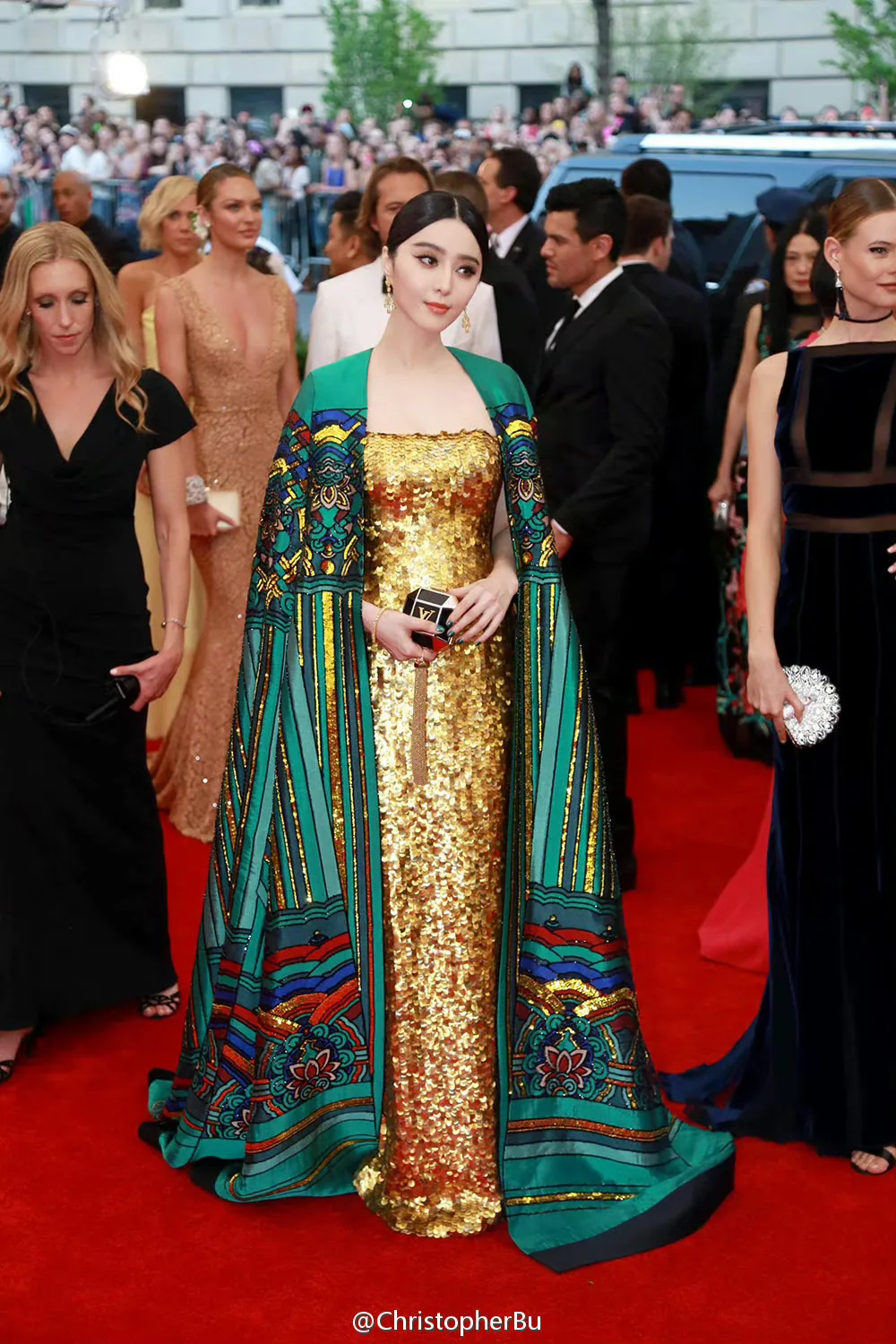
Jacquard on a museum-scale stage
The Forbidden City jacquard cape worn at the 2015 Met Gala. A motif woven into the cloth, not appliquéd onto it. The reason jacquard reads correctly under camera flash at fifty metres.
Read the jacquard case study →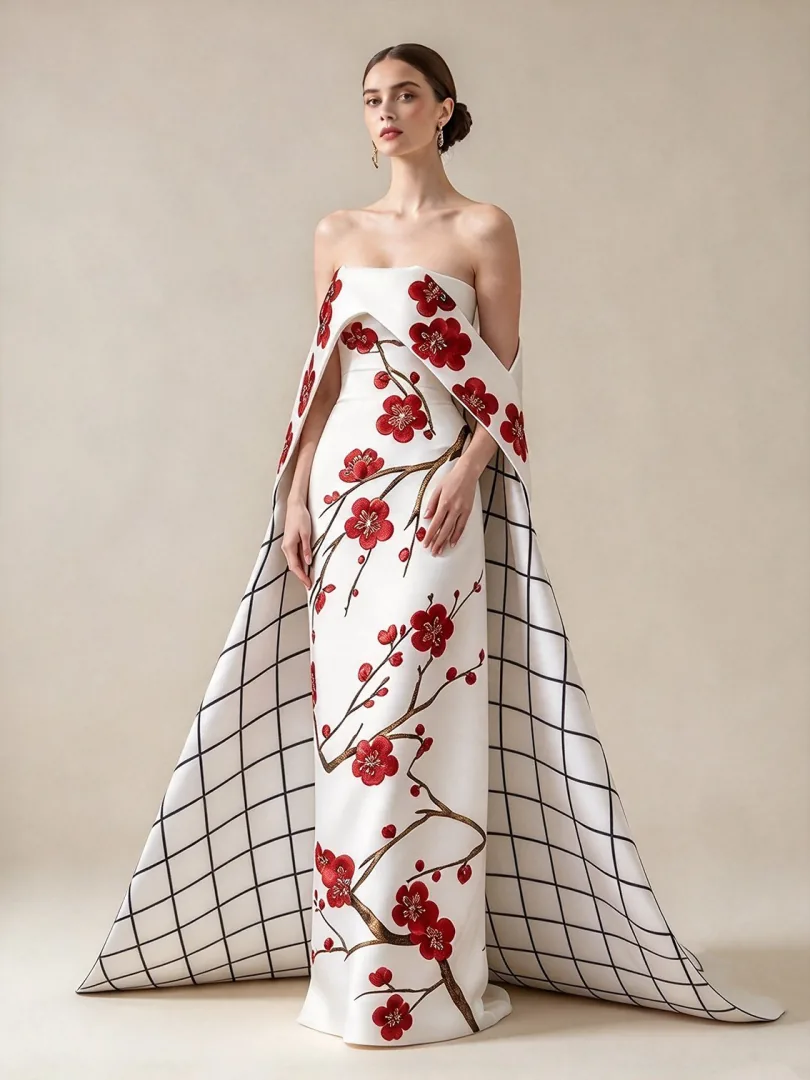
Hand embroidery on silk
A white mulberry silk gown with red plum-blossom hand embroidery. Cloth at this weight has to carry stitch tension without puckering. The failure is invisible until the light hits it.
Read the Oscars case study →
Where the fibre starts
Yizhou, Guangxi. The raw silk origin the local mills we work with draw from. The full production record. What the official figures actually say.
Yizhou raw silk →What this page does not claim
We do not stock all 22 constructions, and a table that implied otherwise would waste your time at the sampling stage. Five constructions in the list — mikado, gazar, radzimir, faille and peau de soie — are quoted only after we confirm capacity, and we deliberately publish no minimum and no price for them here.
We also do not publish a price per meter on this page. Silk is quoted against a specification: grade, momme measured on finished cloth, width, colour route and quantity. A single headline number would be true for one combination and misleading for the rest. The pricing logic is set out separately in the silk fabric price guide.
Questions buyers ask before sampling
How many types of silk fabric are there?
There is no fixed number, because a type is defined by three independent things: the weave, the weight and the finish. In commercial practice most mills work with roughly 20 to 30 named constructions. This page covers 22 of them, from habotai at 5 momme to peau de soie at the heavy end. The same yarn can become a chiffon or a mikado depending on how it is woven and finished.
What is the difference between silk fabric types and silk grades?
Grade describes the fibre — 4A, 5A and 6A refer to evenness, cleanness and neatness of the raw silk filament. Type describes the cloth — how those filaments were woven. A 6A yarn woven into a loose chiffon is still a 6A yarn, and a low-grade yarn woven into a heavy satin is still low grade. Buyers who only ask about momme, or only ask about grade, are each holding half the specification.
Which silk fabric is best for evening gowns?
For a gown that has to hold a sculpted line, 19 momme and above: dupioni, heavy satin, or a jacquard over a structured base. For a bias-cut gown that should move, 16–19 momme satin or charmeuse. The failure mode in both directions is the same — cloth chosen for how it looks flat on a table rather than how it behaves on a body under light.
Can you supply silk fabric in small quantities?
Mini fabric samples can be supplied without a material charge once availability is confirmed; the buyer bears courier, customs and related international shipping costs. Full-size fabric and finished garments are chargeable. Bulk minimums depend on the construction, the width and whether the colour is a standard shade or a custom match, and are confirmed in the written quotation rather than quoted as a single number here.
Do you sell silk fabric by the yard or by the meter?
We quote by the meter for export orders, and the product pages state the width the price refers to. Buyers working in yards should confirm the conversion at quotation stage rather than assuming a 1:1 relationship — a 114 cm width and a 140 cm width are not interchangeable when you are costing a marker.
Are gazar, mikado, radzimir, faille and peau de soie available?
These are woven to order through the local mills we work with, and we quote them only after confirming the construction, width and colour against current mill capacity. We do not hold them as stock items, and this page does not state a minimum or a price for them. Ask for a sample and we will tell you honestly whether the construction is available for your quantity.
Is your silk fabric dyed to order?
Yes, on both tracks: standard shade card colours, and custom colour matching to a submitted sample or a specified reference. Greige fabric is also supplied undyed for buyers running their own dyehouse. Colour is what we quote for; surface effects beyond dyeing are a separate conversation and we will say plainly whether they are available.
Continue through the sourcing guides
Yizhou raw silk
The origin, the official production figures, and why the fibre behaves the way it does.
Open guide →The momme guide
What momme measures, how to convert it, and why a greige figure overstates finished weight by a fifth.
Open guide →Wholesale silk fabric
How a bulk order runs from first enquiry to container, including sampling, dyeing and QC.
Open guide →Silk fabric price guide
What moves the price and how to compare two quotations that use the same words.
Open guide →Send the garment, not the fabric name
Tell us what you are cutting — silhouette, season, quantity and the hand you want — and we will come back with the construction, the weight and a sample list. Mini samples carry no material charge; you cover the courier.
Sources and method
Methodology: the weight ranges on this page are commercial ranges agreed with the mills, not a mill guarantee for every roll. The finished-weight figure is the one quoted in a written specification. Denier and grade follow GB/T 1797-2008, the national raw silk standard. The origin statements rest on the Yizhou district government and Hechi civil affairs publications. Red-carpet descriptions follow the contemporaneous coverage listed above. The silk attribution for those garments rests on the atelier's own production records. Availability states are checked against the product pages on this site. A construction marked sample on request is not a stock claim.
- Standardization Administration of China: GB/T 1797-2008 生丝 (Raw silk) (2008). The national standard that defines raw silk grades and the denier notation used in the weight discussion on this page.
- Yizhou District Government: Yizhou district profile (2023). The mulberry acreage and reeling capacity behind the origin statement, and the county's sericulture record.
- Hechi Civil Affairs Bureau: Hechi place names: Yizhou (2025). Mulberry field area and cocoon output for the district, used to describe supply scale rather than a mill's capacity.
- Haiwainet: Fan Bingbing's Forbidden City look wins praise (2015). Records the 2015 Met Gala gown as pure silk, with colours taken from the palace bracket paintings.
- Global Times: Chinese designers look to change Chinese fashion industry (2018). Names the Snow Plum Blossom gown worn at the 2018 Academy Awards and places it in the Forbidden City couture series.
Reviewed by the Christopher Bu editorial team. Corrections and sourcing queries go to the B2B team, and the editorial standard is the same one used on the about page.