

From the Land of Longevity to the World's Red Carpets: Yizhou's Mulberry Silk
Yizhou, a county in Guangxi in southern China, holds two titles that rarely sit together. It is a recognized longevity town, with more than 70 people over a hundred years old, and it is the largest mulberry silk producing county in the country, a position it has held for 21 straight years. The silk that starts here ends up on red carpets in Paris, Hollywood, and New York, and it is the base of the couture gowns this label designs.
A longevity town that also grows silk
Yizhou is in Hechi, in the northwest of Guangxi. In 2015 the China Gerontology Society named it a China longevity town. The Yizhou district government counts more than 70 residents aged over a hundred, and a population average life expectancy of 79.52 years1. The oldest person on record from the region, a man named Lan Xiang, is said to have lived to 146 and received a poem from the Jiaqing Emperor. The same county is the country's largest mulberry silk producer. Since 2005 its mulberry field area and fresh cocoon output have ranked first among China's counties every year. By the end of 2023 the fields covered 396,000 mu and the fresh cocoon output reached 115,000 tonnes2. In 2018 the China Sericulture Society named it a China sericulture town. The two facts are not unrelated: the same mild, humid climate that people credit for the long lives also suits the mulberry trees the silkworms eat. For example, the heat and rain that make the valley green also push several silkworm rearing cycles into a single year.
Why the climate suits mulberry
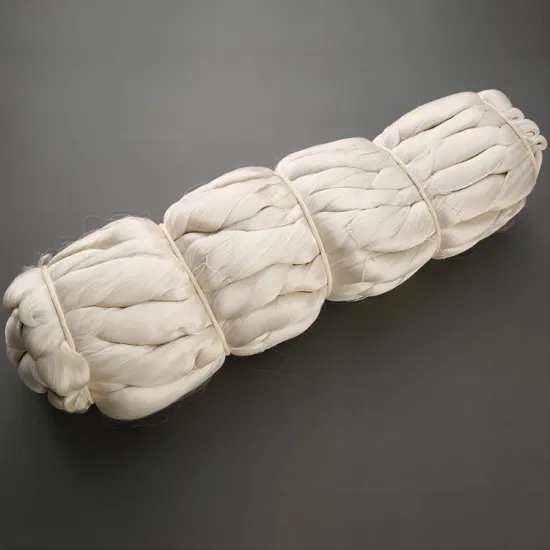
Mulberry trees want warmth, water, and a long growing season, and silkworms want a steady, clean feed of their leaves. Yizhou sits in the subtropics, with a climate that supports several silkworm rearing cycles a year. The county's sericulture has been built up over decades, so the feeding, the reeling, and the grading are practiced at scale rather than improvised. This is what makes the raw silk consistent. The cocoons are reeled into filament and graded, and the graded yarn becomes the input for the weaves that follow. A gown starts with this consistency, because a jacquard loom cannot make a clean motif from uneven yarn.
Related: raw silk yarn for weaving
From cocoon to filature silk
Filature silk is the long, continuous filament reeled from a single cocoon, as opposed to the short fibres left over when a cocoon is broken. Yizhou's mills reel the cocoons into 20/22 denier raw silk, the standard weight for weaving, and grade it from 4A to 6A under GB/T 1797-2008, the national raw silk standard. The grade sets the ceiling for everything woven from it, so a higher grade means a cleaner, more even yarn for a couture cloth. The county does not just rear silkworms. It also reels and weaves, which keeps the value close to home. By the most recent figures the county runs more than a dozen silk reeling mills and several weaving mills, and most of its cocoons are processed locally rather than shipped out raw. This is the industrial layer behind the tourist image of the place.
| Stage | What happens | Output |
|---|---|---|
| Sericulture | Silkworms fed on mulberry leaves spin cocoons | Fresh cocoons |
| Reeling | Cocoons reeled into long filament | 20/22 denier raw silk |
| Grading | Yarn graded to national standard | 4A to 6A grades |
| Weaving | Graded yarn woven into cloth | Greige, jacquard, dupioni |
From cocoon to cloth in Yizhou
The Painted Veil: how a film put Yizhou on the map
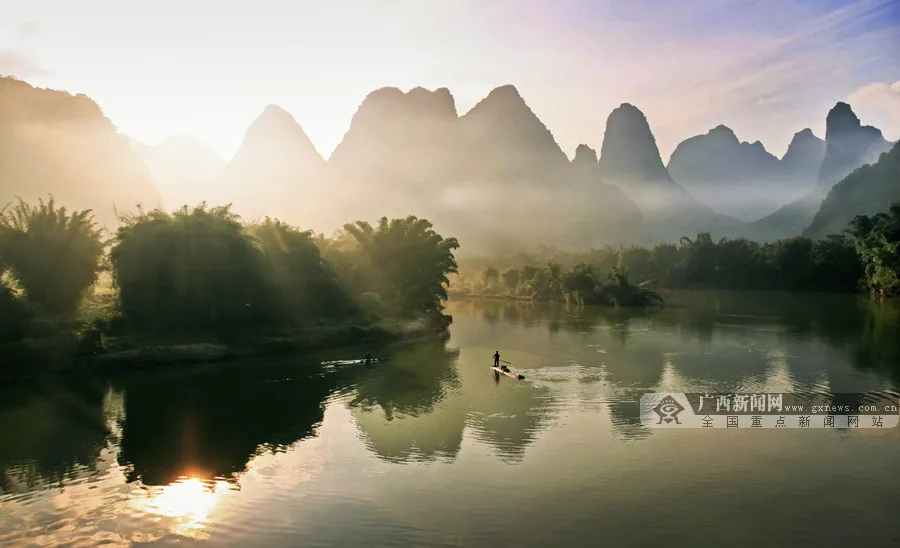
In 2006 a Hollywood adaptation of Somerset Maugham's novel The Painted Veil, directed by John Curran and starring Edward Norton and Naomi Watts, chose Guangxi for its location. The production spent ten days and eight thousand kilometres searching for a landscape that looked like nothing else. It settled on the town of Huangyao and on Yizhou, filming along the Xiajian River, the big waterwheels, and the Xiangbei scenery3. The director's own words, quoted in Chinese press at the time, were that he wanted "a landscape no other country has, only China has," and that Yizhou was, like Huangyao, "unique." The film was the first Western picture about China to be shot entirely in China. It put the region's karst hills and rivers in front of an international audience a decade before the silk gowns did.

A landscape made for silk
The same rivers and karst peaks that read as scenery in a film are the working landscape of sericulture. Mulberry grows along the valleys, and the mild, wet climate that keeps the hills green also keeps the silkworms fed through several rearing cycles a year. At dawn the mist over the water is the same humidity that suits the mulberry leaf, the one input the whole county depends on.
How Yizhou silk reaches the world's red carpets
This is where the longevity town connects to the label. The mulberry silk woven in Yizhou is the base of the couture gowns Christopher Bu designs. The dupioni cut for Fan Bingbing in 2013 came from this silk base, as did the jacquard of the Forbidden City gown she wore to the 2015 Met Gala and the Snow Plum Blossom dress Paz Vega wore to the 2018 Oscars. The silk does the quiet work in each piece: it holds the shape, carries the motif, and gives the gown its movement, while the design and the craft decide what the world sees. The connection runs through three different crafts but one cloth. Dupioni, jacquard, and embroidery all begin from the same reeling and grading, so the consistency of the county shows up as the one thing the three gowns share before the design diverges. A buyer who wants that consistency is really asking for the same origin, not the same style. The label's own production records place the silk for these gowns in Yizhou. What the press photographs of those red-carpet moments do not show is the county behind the cloth, a place that has grown more silk than anywhere else in the country for two decades.
Related: read the dupioni story · read the jacquard story · read the embroidery story
What this means for a buyer of mulberry silk
For a buyer, the origin matters in two ways. First, it explains consistency: a region that rears and reels at this scale, and grades to a national standard, produces a yarn you can specify and reorder. Second, it explains availability: the largest mulberry silk county in the country is the kind of place that can meet a bulk order without improvisation. When you specify silk, name the weight, the weave, and the grade you want, and ask where the silk is from. A supplier who can name the region and the grade is working from a real supply, not a guess.
Related: dupioni silk greige · request a swatch · about us · contact the B2B team
Sources
Each bracketed number in the text points to the source below that backs it.
- [1]
Yizhou District Government — Yizhou district profile (2023) open
The longevity town title, the centenarian count, the life expectancy, and the 21-year sericulture record.
- [2]
Hechi Civil Affairs Bureau — Hechi place names: Yizhou (2025) open
The sericulture town title and the updated mulberry and cocoon figures.
- [3]
People's Daily — Following the light: film locations in China and abroad (2015) open
The Painted Veil's Yizhou location and the director's account of choosing Guangxi.
- [4]
Guangxi News Network — Yizhou's Xiajian River named one of China's most beautiful hometown rivers (2017) open
The landscape photographs of the Xiajian River and riverside dawn used on this page, credited to Wei Binghua and Wu Jichun.
Methodology: the longevity and sericulture figures in this page come from the Yizhou district government and Hechi government profiles, which publish the county's centenarian count, life expectancy, mulberry field area, and cocoon output. The Painted Veil location history follows the People's Daily feature on film locations and the director's quoted account. The silk attribution for the couture gowns rests on the brand's own production records. This page is reviewed by the Christopher Bu editorial team.
Related: Yizhou mulberry silk →
Request a fabric swatch