


Why Lot Marks and Per-Lot Grading Certificates Must Be on Paper Before a Raw Silk Order Is Approved
A raw silk order should not be approved until the lot mark and the per-lot grading certificate are written down. That is the short answer. A grade such as 5A is a claim about one production lot. It is not a property of a product line. Without a lot mark, no document links the claim to specific yarn. Without a grading certificate for that lot, no test result supports the claim. Both fields sit in the written quotation acceptance framework. Both have to exist on paper before a buyer signs.
Consider a first bulk order. A buyer checks 20/22D, 5A and the unit price, then approves. Weeks later a weaving run shows uneven yarn. The buyer asks which lot the grade claim covered. The lot mark and the per-lot certificate were on the quotation. Nobody read them as a test. The paperwork was there. The check was not.
Why a grade claim needs a lot behind it
A grade claim is only checkable when it names a lot. The written quotation states grade and quality tier by lot. The spec sheet lists 4A, 5A and 6A as the tiers. Raw silk grading follows GB/T 1797-2008, named on the certificate check page (Standardization Administration of China, 2008). A buyer who reads 5A as a product attribute will never ask which lot it covers.
A lot mark is the identifier that ties a quality claim to one production lot. A grading certificate per lot is the document that records the test result for that lot. Per-batch evidence is the group of fields on the written quotation that make such a claim checkable. An acceptance test is any field a buyer can check before approving an order.
The raw silk spec page publishes the field list in full. It splits the written quotation into five groups. One of them is the Per-batch quality evidence group. That group holds six fields: grade and quality tier by lot, evenness, cleanness, neatness, lot mark / traceability, and grading certificate per lot.
One root cause explains the gap. A grade reads like a product attribute, so it gets filed with denier and price. A lot mark reads like an internal code, so it gets skimmed. The claim and the evidence sit on the same page. A buyer stops at the first three lines. For a buyer comparing several suppliers in one afternoon, that habit is rational. It is also the moment the evidence disappears.
Consider a claim of 5A on a 20/22D white raw silk yarn. The product page shows denier, grade and finish. That is exactly the trio a first pass stops at. The quotation adds the lot mark. The downloadable spec sheet is the reference a buyer can keep beside it. A grade with no lot attached to it is a word, not a test result.
The per-batch evidence fields on a written quotation
Six fields make a quality claim checkable against one lot. Two of them decide whether the claim can be traced at all. They are the lot mark and the grading certificate per lot.
The table below reproduces the published field list for this group. It is a checklist. Each row says where the field is settled and what a buyer should look for.
Read the last two rows together. The lot mark is stated on the written quotation. The grading certificate per lot is confirmed in writing before order approval. A buyer needs both.
Each field in the framework follows one of two paths. It is either stated in the written quotation, or confirmed in writing before order approval. Knowing which applies is the whole point of the first pass. The framework carries 21 fields in five groups. The full field list on the spec page is the reference for all of them.
Grade availability is confirmed by variety in the quotation, and grades span 4A, 5A and 6A. Moisture is controlled below 11% (Standardization Administration of China, 2008). Those are planning values from the spec sheet. The written quotation carries the final values for one order.
The certificate check page lists the standard and the verification entry points. The trade and shipping terms page sets out the commercial fields that sit beside this group.
| Per-batch evidence field | Where it is settled | What the buyer checks |
|---|---|---|
| Grade and quality tier by lot | Stated in the written quotation | The grade named for a specific lot |
| Evenness | Stated in the written quotation | The evenness value recorded for that lot |
| Cleanness | Stated in the written quotation | The cleanness value recorded for that lot |
| Neatness | Stated in the written quotation | The neatness value recorded for that lot |
| Lot mark / traceability | Stated in the written quotation | The identifier that ties the claim to one lot |
| Grading certificate per lot | Confirmed in writing before order approval | The test result document for that lot |
What a lot mark traces when cloth reaches a red carpet
A lot mark lets a buyer follow cloth backwards. The site publishes a worked example.
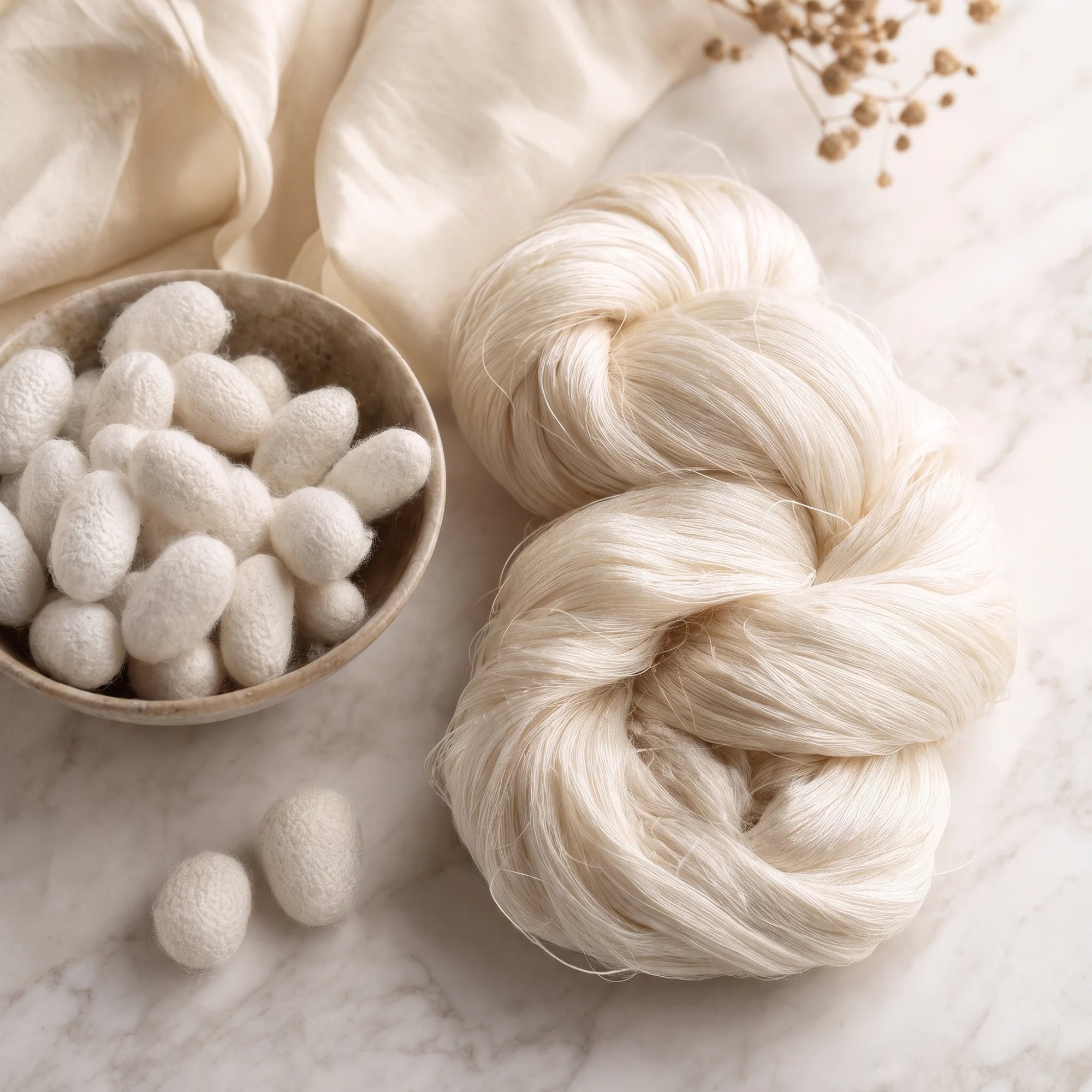
The site states that the mulberry silk woven in Yizhou is the base of the couture gowns Christopher Bu designs. It names three garments: the dupioni cut for Fan Bingbing in 2013, the jacquard Forbidden City gown she wore to the 2015 Met Gala, and the Snow Plum Blossom dress Paz Vega wore to the 2018 Oscars. Tagged as a first-party record, "the label's own production records place the silk for these gowns in Yizhou" (Christopher Bu, Yizhou mulberry silk archive, 2026). The 2013 pieces are "cut from the same dupioni we supply as greige today." The site names these gowns specifically; it does not say every gown or season used this silk.
The spec link is concrete. The spec sheet lists 20/22D as standard denier, natural dupion silk yarn among four varieties and greige (undyed) as a finish on all products (Christopher Bu, raw silk spec sheet, 2026). Local mills reel 20/22 denier raw silk graded 4A to 6A under GB/T 1797-2008 (Standardization Administration of China, 2008), and the site's Yizhou article says a jacquard cannot make a clean motif from uneven yarn. So the evenness a buyer checks per lot, tied by the lot mark / traceability field, is the property that let the Forbidden City jacquard carry its woven motif. The greige dupioni a buyer orders today is the cloth the site names behind the 2013 pieces. That is the audit trail lot-level traceability buys: a finished gown back to a grade, a lot and a Yizhou origin.
Keep the boundary plain. The records name an origin and a cloth, not a lot number, a certificate number or a formal traceability scheme. The about page describes sourcing raw silk, greige fabric and dupioni from local mills, with Yizhou as the geographic origin. One 2013 piece called "stamp-printed" is a finished archive garment, not a service offered to buyers.
A judgement method: the lot-to-document check
One method turns the field list into a decision. Work backwards from a grade claim and name three things. Name the lot mark. Name the grading certificate for that lot. Name the written confirmation date.
The methodology is plain on purpose. Take a claim of 5A. The evidence that satisfies it is the grading certificate for that lot, plus the lot mark that ties the two together. The moment it must exist is before order approval. Working backwards from the claim gives a buyer three checks: the mark, the certificate, and the date.
The lot trail is the chain from a grade claim to a lot mark to a per-lot certificate. If any link is missing, the claim stays open. For example, a buyer can hold a certificate with no lot mark and still not know which bale it covers.
Take the test method reference. A buyer who treats it as a test asks which standard the inspection report used. The published spec names GB/T 1797-2008 for raw silk grading. A buyer who treats the line as boilerplate never asks. The inspection report then arrives with no agreed method behind it.
The same move works on the certificate number. It comes with the written quotation and the shipping documents. Treat it as a scope claim, then ask which public entry confirms it. The spec page is the reference for this method. Work down the per-batch group once, in order, and mark each row as open or closed.
Where certificate numbers come from and how to check them
Certificate numbers are provided with the written quotation and the shipping documents. A number alone proves nothing until its scope matches the goods.
Both sides confirm certification in writing before order approval, within each document's listed scope. Certification for qualified buyer review covers GOTS, OEKO-TEX STANDARD 100 Class II, China Organic and quality-system files. The written quotation states the certificate number. The shipping documents carry it again. A buyer can then check the number against the issuing body before signing.
The certificate check page lists two entry points. The OEKO-TEX label check lets a buyer confirm a label and its scope (OEKO-TEX Association, retrieved 2026-11-06). The GOTS public licence database does the same for organic status (Global Organic Textile Standard, retrieved 2026-11-06). Raw silk grading follows GB/T 1797-2008 (Standardization Administration of China, 2008).
Destination-market compliance works the same way. Buyers check California Prop 65 and EU textile safety requirements against product-specific test reports. Both sides confirm them in writing before order approval. Each claim needs one product-specific test report and one written confirmation. If either is missing, the field stays open.
Raw silk (not thrown) falls under HS heading 5002. The written quotation and shipping documents confirm the exact subheading, never one fixed code for every order (World Customs Organization, Harmonized System heading 5002). The trade terms page repeats the rule. The spec sheet calls its own values planning values, checked against current availability before quotation. The written quotation carries the final spec, MOQ, schedule, applicable HS subheading and organic status.
What to do before you approve
Before you approve an order, ask for the field list on paper. Read the per-batch group all the way through.
Request a written quotation and read all five groups against the published field list. Ask for the lot mark and the grading certificate per lot in writing. Tick each row of the per-batch group. A quotation that survives every group is a document a buyer can sign.
Keep three documents together: the written quotation, the downloadable spec sheet, and the signed order documents. The sample request page covers the swatch that should arrive with the quotation. A sample without a named test method proves only that the sample looked right. A method turns the sample into evidence.
Work through these lines at a desk before approving any raw silk order:
- Name the lot mark that ties the grade claim to one lot.
- Ask for the grading certificate for that lot, confirmed in writing before approval.
- Check the test method reference and ask which inspection report it governs.
- Fact check every certificate number against the public database, then confirm the scope in writing.
- Keep the written quotation, the spec sheet and the signed order documents together.
- Read the whole per-batch group, not just the grade line.
Finish is greige (undyed) or dyed to order from a standard shade card or a custom colour. Both are available on all products. The product range lists four varieties. They sit beside the per-batch group, and a buyer should read both.

Is a grade claim tied to a lot automatically?
No. The written quotation states grade and quality tier by lot, and it states the lot mark. A buyer still has to read both lines together. A grade with no lot mark attached is a claim with nothing to check against.
When is the grading certificate per lot confirmed?
Before order approval. The lot mark is stated on the written quotation. Both sides confirm the grading certificate per lot in writing before the order is approved. That written confirmation is the moment the test result becomes binding.
Do certificate numbers appear on the quotation?
Yes. Certificate numbers are provided with the written quotation and the shipping documents, within each document's listed scope. A buyer can then check each number through the OEKO-TEX label check or the GOTS public licence database.
Are 4A, 5A and 6A available for every variety?
No. The written quotation confirms grade availability by variety. The spec sheet lists 4A, 5A and 6A as the tiers, and grading follows GB/T 1797-2008. Check availability against the chosen variety, not against the tier list alone.
Sources
Each bracketed number in the text points to the source below that backs it.
- [1]
Beijing Qingshanyimu Trading Co., Ltd — Raw Silk Yarn 20/22D: B2B Buyer Spec Sheet (2026) open
- [2]
Beijing Qingshanyimu Trading Co., Ltd — Raw silk specs: what every written quotation includes (2026) open
- [3]
Standardization Administration of China — GB/T 1797-2008 Raw silk (2008) open
- [4]
World Customs Organization — Harmonized System nomenclature (n.d.) open
- [5]
OEKO-TEX Association — Label Check: certificate and label number verification (2026) open
- [6]
Global Organic Textile Standard — Public certified-supplier and licence database (2026) open
- [7]
Beijing Qingshanyimu Trading Co., Ltd — Yizhou mulberry silk in the Christopher Bu couture and red-carpet archive (2026) open
Related: certificate check →
Need a shade card or a quotation?
Greige or dyed to order from a standard shade card, with custom colour matching available. Tell us your fabric, quantity and destination and our B2B team will reply with a tailored quotation.