


Momme vs Denier: How to Read Silk Specs Before You Order
If you are specifying silk for a gown, you need two numbers. Momme tells you the weight of the cloth; denier tells you the thickness of the yarn. They measure different things, and a buyer who reads them together gets the fabric right the first time instead of ordering a weight that feels wrong in the hand.
What momme measures
Momme is a unit of silk fabric weight, equal to about 3.75 grams per square meter. A higher momme means a heavier, more structured cloth, and a lower momme means a lighter, softer one. The number comes from the weight of a standard bolt, and it is the figure a mill quotes when you ask how heavy the silk is1. For gowns the useful range is narrow, and it helps to think of it as a band rather than a single number. A 19 momme double crepe is the entry weight, light enough to move and heavy enough to hold a silhouette, while a 22 momme fabric has more presence and is what a structured evening gown wants. Below 19 the cloth starts to feel like a lining; above 30 it reads as a jacket or coat weight. For example, the same dress cut in 19 momme drapes softly, where the 30 momme version stands away from the body.
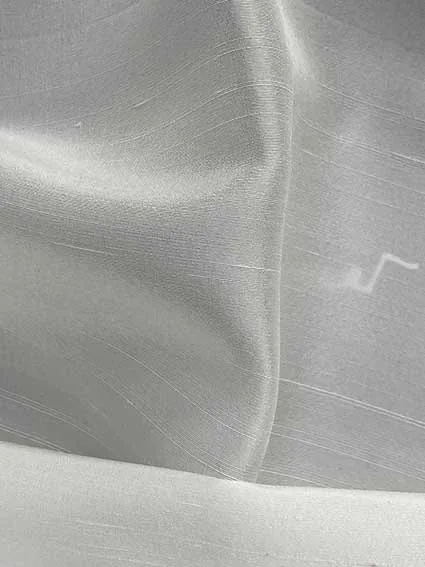
What denier measures
Denier is the yarn's linear density, measured as grams per 9,000 metres, and it describes the thread rather than the cloth. The standard mulberry raw silk yarn is 20/22 denier, reeled from cocoons and wound into hanks for weaving2, with a finer yarn carrying a lower denier and a coarser one a higher denier. The two numbers work together, with denier setting the thread and momme setting how much of that thread goes into a square meter of cloth. Two fabrics can share a denier and still differ in momme, because the weave density and the number of plies change the weight without changing the yarn. That is why you read both measurements rather than one. The most common mistake is quoting a momme and ignoring the denier, which produces a cloth that is the right weight but the wrong hand, because the yarn underneath it is not what the design assumed.
| Spec | What it measures | Unit | What it tells you |
|---|---|---|---|
| Momme | Fabric weight | 3.75 g/m² | How heavy and structured the cloth is |
| Denier | Yarn thickness | g/9,000m | How fine or coarse the thread is |
| Width | Cloth width | cm | How much usable cloth per meter |
The two silk specs and what they tell you
Matching spec to use
The right weight depends on the job the silk has to do. For a structured gown, choose a heavier momme double crepe or dupioni, because the cloth has to hold a shape without collapsing under its own weight. For an overlay, choose a lighter fabric that drapes instead of standing. For an embroidery base, choose a stable greige, because the ground has to hold still while thread is stitched into it. The rule is simple: match the spec to the end use. A gown cut from overlay-weight silk will not hold its line, and an overlay cut from gown-weight silk will not fall. Naming the end use before you name the weight avoids the most common ordering mistake.
| Weight | Approx. gsm | Typical use |
|---|---|---|
| 19 momme | 82 gsm | Dresses, blouses, lining-adjacent gown work |
| 23 momme | 100 gsm | Structured evening gowns, bridal |
| 30 momme | 129 gsm | Tailored jackets, heavier couture |
| 40 momme | 172 gsm | Coat-weight pieces, structured suiting |
Momme weights and their typical uses
Related: dupioni silk greige · raw silk yarn for weaving
Specifying your order
Name the end use first, whether that is a gown, an overlay, or an embroidery base, then pick the weight that matches and confirm the hand on a swatch before ordering bulk.
Related: request a swatch · about us · contact the B2B team
Sources
Each bracketed number in the text points to the source below that backs it.
- [1]
XINGYE TEXTILE — Dupioni Silk Fabric: Properties, Types & Wholesale Sourcing Guide (2024) open
The momme weight unit and the weight range used in the momme section.
- [2]
国家标准化管理委员会 — GB/T 1797-2008 生丝 (Raw silk) (2008) open
The 20/22 denier raw silk designation and grading scale used in the denier section.
Methodology: the momme and denier definitions and the weight table in this page come from the supplier's standard spec sheet, the same figures quoted to buyers. This page is reviewed by the Christopher Bu editorial team.
Related: momme fabric weight →
Request a fabric swatch